Tuesday, March 8, 2016

SWITZERLAND – Alpine Vistas


Switzerland is an insanely scenic country.  And the International Olympic Committee knows where to pitch its headquarters – in Lausanne, Switzerland. With its story-tale view of Lac Leman with Les Jumelles mountainous silhouette rising from it, Lausanne must be one of the most beautiful spots on the globe.
And that’s where I found myself for another sabbatical year to spend with the Ecole Polytechnique Federal in Lausanne as a Visiting Professor. A French-speaking branch of the famous ETH Zurich, the EPFL has its campus in the Lausanne suburb. In their pragmatism, the Swiss do not hesitate to appoint foreigners even to permanent professorial posts so prestigious in their society.
And one can function and lecture in English – the whole campus, even outside of it, speaks it quite fluently.  My colleague there, quite a distinguished gentleman and scholar, graduated from the UC Berkeley and we had our bio-thermodynamics in common.
To provide a background connection, I should mention that he was also a high ranking officer in the Swiss army. Yes, the proverbially ‘neutral’ Switzerland has an army and quite a powerful one.  That’s because they believe in ‘neutrality with strength’ and it seems that everybody has a tank in their barns or at least a machine gun in the closet. And they keep honing their military skills on weekends.

When I was blissfully skiing one of the wonderful resorts close to Lausanne, a screaming duo of jet fighters suddenly popped low over the ridge and dove down into the valley, skimming the rugged mountain contour, much faster than my downhill speed. And I almost went into a similar dive head first hearing their engines mighty roar as they ascended from the valley again skimming the opposite mountains. Insane crazy pilots !
When I mentioned this experience in our EPFL cafeteria, my ‘army-professor’ casually remarked:  Oh-yes, it must have been Carl from the neighbouring department, he is a jet-fighter pilot and they practice their runs on the weekend”. I also learned that their magnificent flying machines actually fly out of the mountain where they are hidden underground. Crazy pilots, crazy Swiss airforce !

Along the same line, as their eyes are pointed upwards admiring the gorgeous mountain vistas, a few tourists in Switzerland notice the cut-contours in the surface of Swiss highways. These are anti-tank obstacles that would rise up in case of danger. Also numerous mountain tunnels are constructed and equipped for their role as back-up military storage depots or hospitals. Well, just realize that there must be a reason why the pope’s safety is guarded by the Swiss guard.
But that’s all under the surface, none of it is conspicuous at all in the peace and tranquility of those majestic mountains providing challenging and view-rewarding hikes everybody undertakes at the echoing sounds of cow-bells from all over.

Apart from the Swiss military surprise, I was flabbergasted at the sight of an already retired, extremely rare and extremely powerful super-computer exhibited in one of the EPFL hallways. Only the Pentagon and NASA had a few similar ones. One can do some thermodynamics with such gizmos around.
We did what we could – and enjoyed the views and hikes too -


After the demise of the exquisite Swissair airline, “Swiss air” became a recent country brand term - in addition to famous “Swiss banking”, “Swiss knife”, “Swiss watch”, “Swiss cheese” and other quite effective marketing of the Swiss brand. This kind of national promotion breeds togetherness that is an envy of other nations.  


The “CH” label on Switzerland-registered cars means “Confederatio Helvetica” (latin). This is not common knowledge and the title dates back to 1291.

Switzerland is a fine example of modernized historically based democracy. Its four official languages do work for the country, as does the cantonal basis (26) and frequent referendums.

Apart from its breathtaking natural scenery, Switzerland is renown for hard-work ethics and togetherness of its people, excellent educational system, technological prowess and independence.

Switzerland is the birthplace of the Red Cross, home to numerous international organizations, including the second largest UN office. On the European level, it is a founding member of the European Free Trade Association, but notably it is not part of the European Union, nor the European Economic Area. However, the country does participate in the Schengen Area and the EU's single market through a number of bilateral treaties.

" Unus pro omnibus, omnes pro uno" (Latin) , " One for all, all for one" is a Swiss national motto (traditional), thus NOT necessarily an exclusive one of the three mousketeers.

And another "Swiss" delight - Swiss raclette, wonderful food togetherness - look :


Sunday, March 6, 2016

The PHILIPPINES - 7,000 Islands


I like water and sunshine – both are plentiful in the Philippines so that country was on my wish list to visit. With a wink, I remark that it is important to chose an area of one’s research , well, very thoughtfully.  In my biosorption research we identified the need for certain seaweeds, namely Sargassum. So when I noticed that there was a world congress of the Seaweed Society in Cebu City, I thought that I should be there. And how right I was ! While this was not my “scientific crowd”, I was also invited by the Cebu Chapter of Chemical Engineering to deliver a few lectures.
I was glad I made it there.  The Philippines are a mix of the local culture with strong Spanish and American influences left over from periods of supremacies. Cebu City happens to be the oldest city in the Philippines but one would never guess that. Just look at it here, all modern. Note the favorite Philippino local street transportation “jeepneys” – somewhat over-decorated, small open busses. Or the outrigger boats of all sizes, small ones powered by paddles, bigger ones are motorized (photo below). This tropical archipelago is as far from Canada as could be – not only geographically but almost in all aspects. Via Vancouver, Hong Kong and Manila, I made my way to Cebu City on Cebu Island, the Conference location.  Needless to mention, I was already in contact with the local University colleagues and was delighted to meet them.  I barely settled down in the tropics and the Conference was starting. Well, almost starting.  The world-wide science crowd of some 800 people was all gathered for the opening address – that could not start. The electricity conked out. The Conference Chair’s presence of mind saved the situation by initiating an impromptu open general debate - until the electricity comes back on. Any questions or comments from the audience ?

My arm somehow shot up by itself – please go ahead:  I am an engineer totally out of my depth here among you esteemed bio- and algo-logists.  But I have a challenge for you. For the application of a new biosorption process that we conceived and are developing we might need 15,000 tons of Sargassum seaweed. Could anyone here tell me where and how to get hold of it ?” The response of the gathered scientific crowd was only short of dropping a bomb.
That innocent challenge stirred a totally overwhelming debate about it. Why so much ?
I explained the detoxification of some billions of gallons of water gathered and rising in an open-pit mine in Montana. We need to remove the toxic heavy metals from it and dried sargassum biomass was identified as an excellent agent for it. Larger quantities of Sargassum are not being commercially produced – could they be ? This fired up all the algologists’ imagination – and I was just besieged by questions - and offers.

The Philippines, with all the (shallow) water around are a major producer of numerous types of algae, for all kinds of purposes and applications. Local producers, also present at the Congress, became very excited too.  And later, I went touring their “water farms” all around Cebu. That way I got to see what few people have the opportunity to. Often, I heard laud boom-noise like artillery firing. What was it ?
Dynamite”, was the subdued shy answer, “illegal fishing with dynamite and there is nothing that we can do about it. The poachers are just too powerful and too dangerous.”  
My goodness, the realities of life shook me up.
But we did find big patches of Sargassum growing around. And I carried home with me a 30-kg plastic bag of dry compressed biomass as a “sample” gift for our research tests. Yes, it worked and awaits scaling it up. Plentyful supply of the seaweed biomass could be secured from the Philippines – and Indonesia, and other warm-sea locations around the world. Just go and do it – anyone ?

Outrigger boats of all sizes are omnipresent on water. We used one from the local Oceanographic Department – to look for Sargassum, of course.


Seaweeds are a labor-intensive big industry in the Philippines:


And how about some Philippino food ? Fish, of course - but with so many islands this may get a little complicated. So just a little cross-section perhaps ? Look :


Friday, March 4, 2016

BRAZIL – African Drops


Every one of us has at least a drop of African blood in our veins”, confided an academic friend of mine when I arrived in Brazil. And it seems that Brazil is probably the most mixed-blood country in the world, living it up happily. I experienced Brazilians as a smiling, polite, fashionable and generous bunch. We travelled somewhat through the center of the country - and it is a huge country – thanks to what we eventually called “the academic bio-circus”. One Brazilian colleague career researcher selected us and organized a seminar tour labeled “Microbes and Metals”. Dr. Stoyan Groudev - a Bulgarian expert, Dr. Lynn Macaskie – an outstanding British microbiologist, and myself – a bio-engineer. And we went explaining what microbes can do with metals – quite a bit, actually. We teased enthusiastic Stoyan with his own closing phrase “Biosorption is not only technologically feasible but also economically attractive” – it became proverbial.
Our Brazilian scientific audiences were invariably very enthusiastic and we forged  many connections, even friendships.  As a result of this first extensive tour I ended up later teaching a course in Belo Horizonte (state Minas Gerais - with hearty food !) and I also toured (again) up the warm and breathtakingly scenic Brazilian coast in search of our key research material, biomass of seaweed Sargassum. That taught me another little lesson – to not believe local oceanographers. Wherever they pointed out the possible presence of Sargassum, there was none – and it was somewhere else. Flying, I hopped along the warm Atlantic coast of Brazil, searching all the way from the level of Sao Paulo, through Rio de Janeiro, to Salvador, Aracaju, Maceio, Recife, Joao Pessoa, to Natal – there is the point of the South American sub-continent that is closest to Africa. The waves rolling onto Brazilian beaches across the Atlantic come unimpeded all the way from Africa.
With a dune buggy we bumped along stretches of some of those beautiful beaches, mostly empty, some with beautiful huge dunes. Where the ancient Portuguese and Spaniards looked for gold, we searched for Sargassum. The European invaders actually did find their treasures but further inland, at places like Ouro Preto - the whole state there is named Minas Gerais because of the mining activities.
Ouro Preto is a wonderful small mountain town, a UN historic site, populated to a good degree by the Federal University. On an inland tour we even got to see an actual large-scale operation of a gold mine – with a toxic cyanide waste lagoon and all. Pollution aspects get out of hand in uncontrollable Amazonian jungles where river-   and other gold deposits are being (illegally) extracted with mercury. The creeping toxicity of mercury spreads from there to almost around the globe. Expansive Brazil is hard to get to know throughout, let alone controlling it throughout its faraway places and wilderness.
It is a vast country that stretches from the steaming hot Amazon Basin in the north to vineyards and massive IguaƧu Falls in the south. Rio de Janeiro, symbolized by its 38m Christ the Redeemer statue atop Mt. Corcovado, is famed for its busy Copacabana and Ipanema beaches as well as its enormous, raucous Carnival festival, featuring parade floats, flamboyant costumes and samba. Despite of the peaceful nature of Brazilians who did not conduct a war for some 200 years, the crime in most brazilian cities has become vicious and it is spreading. Brazilian middle class is bucking the world trend as it is abandoning family house dwelling in favor of fortress-like gated communities or high-rise condos that conspicuously pierce the city skyline all over. While the bottom of the society scrapes living in the impossible lawless favelas :


It will be interesting how Rio de Janeiro will control its infamous crime and favelas during the 2016 Olympic and Paralympic games.

Brazilian music rhythms are rich and probably the most sophisticated in the world. It seems that simplistic booom-booom of the western contemporary music can only play a ‘second fiddle’ to that of Brazil.
 
What helped me to understand the soul of Brazil were novels of Jorge Amado (e.g. Gabriela, Clove and Cinnamon ) – I recommend that you read some.

And I have not seen the mighty Iguazu Falls in the South of Brazil – yet :


Rio de Janeiro is probably the most beautiful city in the world. One cannot see Brazil without seeing Rio :


Brazilian eating is as varied as Brazilian scenery - but one should NOT miss Brazilian "churasco" - meat. And yes, you can replicate it even at home - look here :


Wednesday, March 2, 2016

CHINA – Truly Great Leap


You godam’, murderous S.O.B.”, was in my mind when I first stood on Tiananmen Square in Beijin and looked dejectedly at the line-up waiting to enter the mausoleum of Mao Zedong.
And make no mistake, this was before the Tiananmen Square massacre and I could not help thinking of Mao’s “Cultural Revolution” and its estimated 20 million victims. Soon, I figured that that estimate could have been even higher as I talked to those who lived through it.

I was in China several times – first even before China opened up its “enterprise China”.  All was drab and uniform at that time and I got almost chopped apart in the rivers of bike traffic flowing quietly in both directions on main streets. China was a crowded country then and I could not imagine how this all would work out now as they were all just dreaming of having a car.  It has been getting crowded by automobiles ever since then.
Also, color was brought to the street as people immediately dressed up when they were allowed to.
The whole Chinese world immediately lit up in impeccably clean shiny colors

I was always living on a university campus, lecturing and getting our joint research ventures started. So I got to talk to people – who all wanted to practice their English. And I learned quite a bit from our discussions. I also learned quite a tasteful bit about Chinese food, especially when in the Province of Sichuan.
There I was a host of the University President which led to an interesting experience. We had a formal meeting together, attended by all the university dignitaries – quite a staged and stiff event.  We were seated next to each other like some statesmen and quite formally went through the agenda. What a surprise later on when we met informally – he was very warm and cordial person who even spoke English rather well.

Always, no matter where I was, I had a personal translator, who was often a guide and a “minder”. He facilitated not only live translation of my lectures but he also accompanied me on most interesting touristic trips as well as local exploratory outings.
My constant companion Sichuanese translator in Chengdu showed me then all kinds of things other foreigners probably have no idea about. An Engineering PhD student, he also divulged his desire to come to Canada. But he would have to know computers, I insisted. An impossible condition since computers were not accessible to students there at all.  OK, he cheerfully agreed. Gradually, we developed a collaborative project with his university and that could make it possible for him to join us in Montreal. In less than 2 years, he not only mastered “computers” in China – he became an expert, teaching all of us. No doubt, there are brilliant people everywhere in the world. Their concentration around that University President – carrying out quite active research in Chemical Engineering at the same time – was somewhat higher as he could select the top talents for his group.

On several occasions, I insisted on trips on my own – realizing that it was not easy at all in a country where one cannot even read the street name. An experience of the Beijing railway station confirmed that. It was totally crowded, I did not understand a single sign, public announcements seemed to have directed the streaming of people in all directions and I did not have a clue just how it happened that I arrived in Tianjin where I was supposed to go.

Similar experience I lived through when I was visiting the terracotta warriors then recently discovered buried outside of Xian. On a big square, buses were departing left and right to different destinations. Some good-soul drivers pointed me to the right one and I did get to see this uniquely  non-sensical archaeological site. Burrying a whole terracotta army ! Apparently, the emperor at the time could not come up with a more sensical idea –
And I even caught the right bus back.

China is truly huge and awfully crowded. I will not even mention its Great Wall, everybody knows it. When I was visiting there, China barely started to open up and develop and I am sure that I would not even recognize it nowadays.  


Guilin is renown for its unique karst topography with steep hills sticking up like stretched fingers everywhere. And water is all around. We took a trip down the river Li to see more. Of course that my pleasant minder was also with me there. Another trip we made to mountains in Western Sichuan, they reach 6,000 meters - we did not.  

Sichuan is renown for its flavorful and hot dishes. I have fond memories of fantastic and not necessarily peppery-hot meals, coming out of dark cave-like eateries surrounding the university campus where I was. We liked testing all of it with my highly cooperative guide.
Thank you, Jinbai, I trust that you are doing well now and I am really proud of your accomplishments.
 

The students, milling around at the chow-time on the campus, were stuffing themselves quickly from their rice bowls held high at the mouth level. And then some time for ping-pong, everywhere on campus on improvised tables. They beat me any time they wanted - but they were also polite -


Underground beverage fermentation pits are family treasures that take decades for developing the right microbial flora to produce very special alcoholic drinks. Their production is still a mystery to me, despite my advanced fermentation background.
Not a drinker, I hesitatingly tried some at Sichuanese markets. Well, different !  Those markets were a special treat - I barely recognized half of the stuff being sold there.


Tuesday, March 1, 2016

RUSSIA - the unhappy USSR


This trip to Russia was extraordinary on many counts and that’s why I want to mention it. Despite that it took place more than half a century ago.  It was my first trip abroad and quite an eye opener to the young man that I was at that time.  It was virtually impossible to travel abroad then during the hard-line commie regime in Czechoslovakia of that period when Russia was really the USSR. 
The crude Czech communist propaganda painted it as an absolutely superior “brother forever” and a “shining example” for us and the world.
We had to use a ‘ruse’ to somehow receive special permission for our expedition which had as its purpose kayak exploration of wild rivers in the Caucasus region.  Actually, a mathematician friend of ours was giving then private math-lessons to a highly placed army general – in his preparation for a high-school final exam ( so called maturity exam). 
That, of course, could speak volumes of the contemporary commie leadership educational level.  And through the word of this general it was how we received a very special permit for 12 of us “paddlers” to take four cars, a few kayaks and all the supplies and go expedition-like for a 7,500 km round trip to the Caucasus mountains. 
And that’s how this enchanting and thoroughly shocking trip originated – to shoot some Caucasus white-water river streams.  Crazy idea – just corresponding to our desire for travel and adventures. And what an eye-opening adventure this was ! 
Never mind that Ukraine, Russia and Georgia that we crossed, are nowadays all independent countries - this was one sweeping trip through a part of what was then one country – the totalitarian USSR. We managed to glimpse at what was, and still is, a truly huge country.  In 1961 it was under quite a hard-nosed communist regime where Khrushchev just took the power. And that empire was militaristic, ruthless and dangerous - but poor, brain-washed, isolated and miserable, historically going through one convulsion after another for centuries.
A little confused just what really to expect, the 12 of us packed 3 colorful Skoda cars and one Russian Volga car with gears, supplies, spare parts – and kayaks on roof-tops.  I emphasize the color of the cars – blue, yellow and red Skodas and a baby blue Volga.  These cars became an apparition to the Russian population all along the way. All that simple Russians were familiar with at that time were olive-green military jeeps and black government Volga passenger cars. 
And zipping by, here came this rainbow streak of foreign vehicles – “You must be Americans ! You are from Czechoslovakia ?  Oh-well, I don’t quite know it beyond the Ural mountains” – we actually heard that many  times.
THE UKRAINE
At that time, there were virtually no foreigners allowed into the USSR and we had a strictly limited access visa for a controlled travel route through Russia. Sure enough, shortly after we crossed the border, a police motorcycle with a sidecar started tailing our little convoy. Bored by a monotonous drive through flat Ukraine we could not help playing a cat-and-mouse game with that Russian accompaniment.  Their clumsy motorcycle just could not keep up when we playfully accelerated on the west-east primitive but relatively smooth highway.  Never mind, they must have thought, radio-waves are faster – and we could notice a police crew waiting for us at every major intersection.  Fine, we just kept to our schedule, reporting into the best hotels (for foreigners) at the end of our driving days in major cities along the way. These were pre-booked for us and expecting us. This part made for a boring drive – but extremely educational.
One could not NOT notice huge fields along the way just before the summer harvest – with tiny rarified wheat overgrown by dominating huge weeds.  Rather disastrous agricultural results !  Certainly far from that “shining example” which our commie propaganda was feeding us with at home.  You remember hearing of those “Potemkin’s villages” ? 
Right along the main road we saw those poor and decrepit villages – the fronts of their primitive wooden houses painted silver (!!).  This “beautification” was likely done with the stolen paint from a gas pipeline that was being constructed toward the ‘West’ right along our route.  That was the only type of paint available to the dirt poor local collective “super-farmers”.  This depressing view was rolling right by us -

Our eyes were just becoming wider and wider as we stopped to overnight on our way through Ukraine, then one of the  Soviet Union republics.  We stopped over in Ukraine's large drab cities on our way East:  Uzhgorod, Lviv, Zhytomyr, Kiev, Kharkiv, and then we turned due south passing through Russian Rostov, Pyatigorsk – and on towards the Caucasus.  The juxta-position and contrast of what we heard and what we witnessed driving through the European heartland of the USSR was just mindboggling. While none of us did believe the manufactured brainwashing propaganda of the commie regime in Czechoslovakia, what we saw around us ‘on location’ was surpassing all our expectations.  Poor and totally brainwashed local folks !

We were an immediate local attraction wherever we stopped. Our ‘special’ hotels were usually on main squares of our stop-over cities – and that’s where ritual late-afternoon promenades of the locals were taking place daily (something like our grandfathers may have remembered at home).
At the end of one day, maybe in Zhytomyr (or could it have been in Kharkiv ?), a few of us were sitting on the first-floor hotel balcony overlooking the gathered crowd below that was thoroughly examining the line-up of our parked cars, even crawling underneath them. A self appointed crowd-leader had a discourse there.  We could understand Russian rather well:
You see, comrades, these are undoubtedly the prototypes of our new soviet cars.  They are equipped for all circumstances. Notice the floats on their roof-tops. It may happen that a road ends at a river – no problem for these cars. They flip over and cross the waterway on those floats. 
We almost flipped from the balcony over this unexpected elevation of our kayaks, obviously never before seen by that population.  Such extraordinary gatherings took place in every city where we stopped.  Incredible encounters as we were mocked by curious crowds –

We spoke Russian and could communicate, engaging in all kinds of discussions. As foreigners (with ‘fancy’ cars !), we were automatically considered to be Americans. Over and over again we were answering curious questions fired from the gathering crowds – who are you ? what jobs ? how much salary ? these were test cars ? – NO, just our cars - and THAT proved to have been just too much for the inquisitors.  Once, after an awkwardly silent pause, a self-appointed crowd leader just declared with a stone face:  But Gagarin - you don’t have ! – and with the air of victorious superiority he walked away.
Russians are marvelously hospitable and warm people – totally unfortunate though, historically.  For centuries, their rulers just brutally have kept them down.

TOWARD CAUCASUS
The deeper south we reached, the more disorganized the country was – and our police supervision eventually lost track of us as we were approaching the Caucasus where we had to, at least symbolically, also touch its highest mountain in Europe – Mt. Elbrus (15,554 ft = 5,642 m). Not acclimatized, we experienced the high altitude sickness already when reaching the mid station Priyut.  The side-trip to Mt Elbrus led through many kilometers of a gorgeous wild river valley (Baksan) where one could spend the rest of life shooting its boiling rapids.

We had just a small exposure to it all, mother nature was overwhelming and our itinerary crowded.  But it was all worth it.  No propaganda, just wonderful mountains and endless whitewater streams –
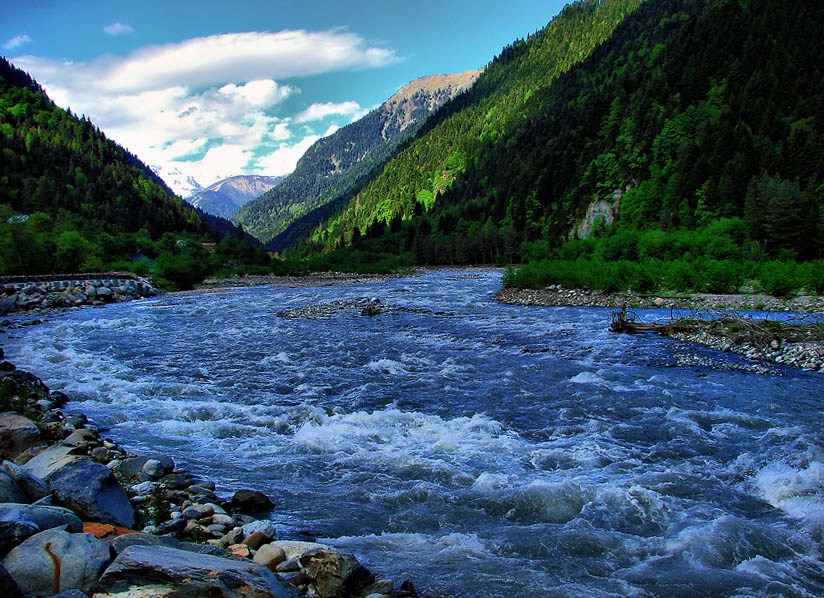
Caucasus  mountains have been dividing continents and cultures since times immemorial.  With a marvel of a road cutting wildly through them – the Georgian Military Road.  One cannot forget the multitudes of wild road switchbacks and not less wild car horn sounds echoing through the valleys as trucks barreled along – when they were not stuck in an endless line-up. The Road is a bewildering mountain range passage that brings northern travelers, not quite safely, across and down south into the plains of Georgia with Tbilisi as its capital and our next destination.
GEORGIA
Quite a different country, different folks and different attitudes.  Despite its long-term association with the Soviet empire, there is a big difference between Georgians and their Russian neighbors across the Caucasus.  Even their simple white shirts and dark pants or skirts strike a more Italian-like resemblance, making a more elegant impression than the lack of taste we noted in rather insular Ukraine that did not seem to have any notion of the rest of the world.
Then locally, we wanted to see Baku, the capital of Azerbaijan.  No dice, not allowed, it was not on our visa itinerary, end of discussion.  So we turned West and continued driving toward Sukhumi on the Black Sea – who will see the sea first ? Many of us had never seen a sea before. Finally !
Recently, I have read somewhere:  “Sukhumi – a beautiful decay”.  Yes, Sukhumi was scenic and simple when we visited – however, mildly said, the region there has been rather tumultuous.
TURNING HOME
At the end of our final land-trip leg was Sochi – a Russian seaside resort town (the Caucasian Riviera), recently made famous through the 2014 Winter Olympic Games.  We also relaxed there for a few beautiful days –
Eventually, we had our cars loaded onto a ship – funny to see them hoisted high, floating on a crane high above our heads. Around, we could not miss a whole bunch of very good-looking girls getting ready to board the same ship.  As we chatted, they turned up to be members of Beryozka dance troupe.  Their company made it easier for us to leave the Sochi paradise and we were looking forward to our sea voyage.  Next morning of the departure, however, a blizzard roared in with 5m waves. 
 
Our huge ship sailed alright but pitched and rolled in the rough seas.  That was not too good for us land-lubbers and my buddy and I wanted to sleep outside in the fresh air, eventually finding a nook right behind the ship’s stack – overlooking the main deck.  That way, we could see the ballerinas promenading right below apparently looking for us.  Our 'destabilized' stomachs, however, made us remain sheepishly in hiding.  The Beryozka ensemble left the boat next day at the next stop-over in Yalta, or was it Sevastopol ?
At the end of our sea voyage was the Ukraine port of Odessa.
The remaining land leg took us relatively fast from Odessa all the way home to Praha.
We covered about 7,500 km through a difficult-to-visit USSR.  We saw and experienced.

And I think that I am digesting this whole trip – still.